
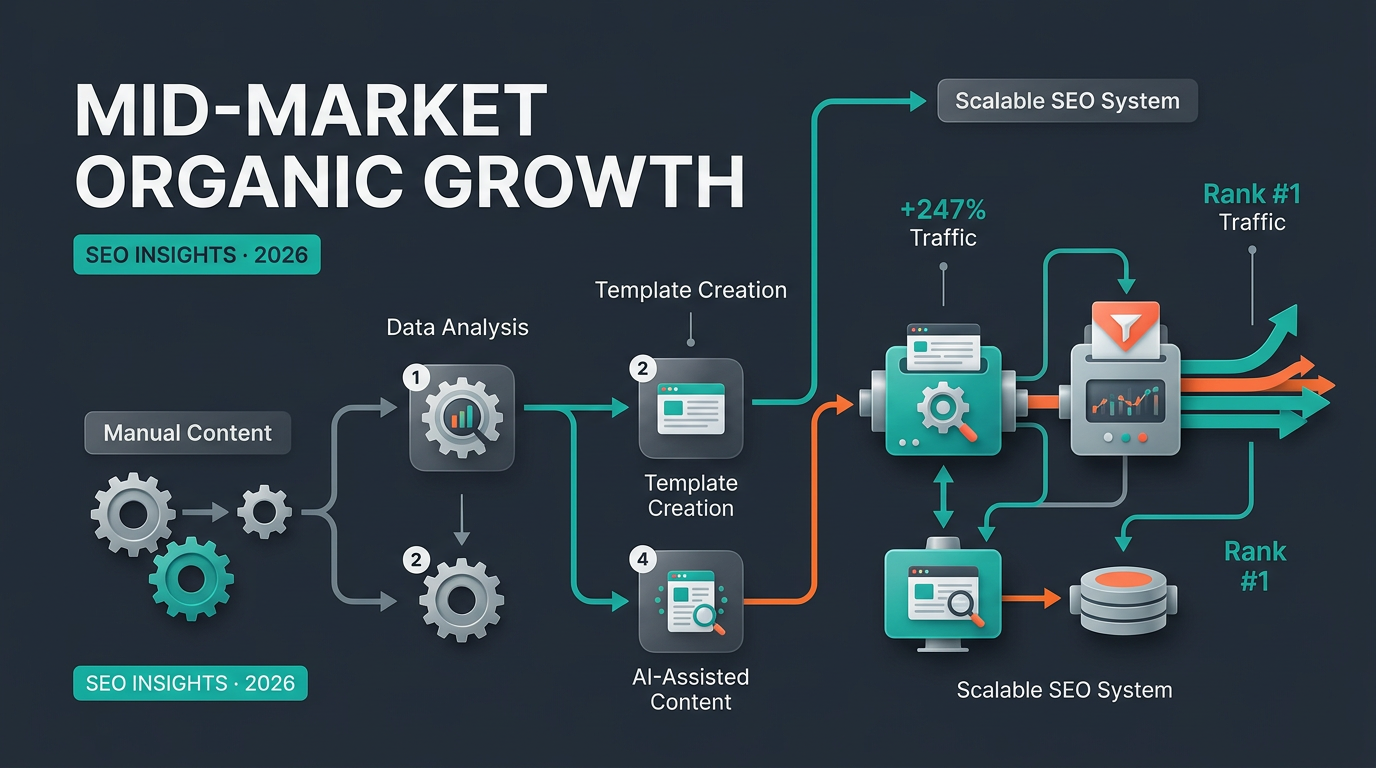
From Content Velocity to SEO Systems: The Mid-Market Shift
You’ve done everything right. You invested in content, targeted the right keywords, built some links, and saw your traffic graph climb steadily up and to the right. But now, you’ve hit a wall. Churning out more blog posts feels like pushing a boulder uphill—the effort is massive, but the results are incremental at best. This is the classic growth plateau, and it’s where many successful mid-market companies find themselves stuck.
If this sounds familiar, it’s because the playbook that got you here won’t get you there. To achieve the next level of scale, you need to evolve your strategy. It’s time to move beyond the linear, effort-for-traffic model and embrace a new framework for sustainable mid-market organic growth. This isn’t about working harder; it’s about building smarter SEO systems that generate traffic with compounding, not diminishing, returns.
The Core of Scalable SEO: Programmatic & Asset-Driven Growth
The secret to breaking through the plateau lies in shifting your mindset from creating one-off articles to building scalable assets. This approach, often called programmatic SEO, isn't just for behemoths like Quora or Amazon. At its core, it's about identifying patterns in what your audience is searching for and creating templated pages to serve that intent at scale. It’s a concept that helps you create hundreds or even thousands of valuable pages without writing a million blog posts from scratch, as some of the largest sites demonstrate by building new features.
For a mid-market company, this is your unfair advantage. You have enough customer data to spot these patterns but are still agile enough to build the systems to capitalize on them. Instead of thinking “What blog post can we write?”, start asking “What repeatable question can we answer with a template?”. This strategic pivot aligns perfectly with the broader shift in mid-market towards disciplined, full-funnel growth marketing, where efficiency and scalability are paramount.
What does this look like in practice for a business like yours? Consider these examples:
- B2B SaaS: Creating a unique, indexable page for every software integration you offer, detailing features and use cases (e.g., “YourTool integration with Salesforce”).
- E-commerce: Building category pages that combine product types with specific attributes or locations (e.g., “Best waterproof hiking boots for women in Colorado”).
- Fintech: Developing a comprehensive glossary of financial terms, with each term getting its own detailed explanation page.
- Services Marketplace: Generating profile pages for every provider in every city you operate in, optimized for local search queries.
Phase 1: Uncovering Your Scalable Opportunities with AI
Your journey into scalable SEO begins with data archaeology. The goal is to move beyond brainstorming individual keywords and start identifying query patterns that reveal a scalable opportunity. These patterns are hiding in plain sight within your own data, and by 2026, AI makes finding them easier than ever.
Start by looking for repeatable query structures, or “syntaxes.” These are search queries that share a common framework but have different modifiers. Think “[competitor] alternative,” “how to [verb] with [your product],” or “[problem] software for [industry].” Your Google Search Console data is the first place to look. Export your queries and look for these recurring phrases.
Next, dig into your internal data—the voice of your customer. Analyze sales call transcripts, customer support tickets, and chat logs. What problems do customers mention repeatedly? What integrations do they ask for? What comparisons do they make? This is your direct line to understanding the “jobs-to-be-done” behind their searches. To systemize this, follow a clear process:
- Consolidate Your Data: Export query data from Google Search Console, your site search logs, and your PPC campaigns. Gather customer questions from your CRM, support platform (like Zendesk or Intercom), and call recording software (like Gong).
- Employ AI for Clustering: Use modern data analysis tools or even large language models (LLMs) to process this raw data. A simple prompt like, “Analyze these 10,000 search queries and group them into clusters based on shared syntax and user intent,” can reveal powerful patterns you’d miss manually.
- Prioritize Based on Business Value: Not all patterns are created equal. Score your identified opportunities based on a simple matrix: Search Volume (demand), Competitive Density (difficulty), and Revenue Potential (business fit). Focus on the high-volume, low-difficulty patterns that map directly to your product or service.
Phase 2: Building Your Minimum Viable Page (MVP) Template
Once you’ve identified a promising opportunity, like “[competitor] vs [your brand],” resist the urge to immediately build out 50 pages. The key is to start small and perfect the core experience first. Your goal is to design a single, perfect “Minimum Viable Page” (MVP) template that is better than anything currently ranking for that type of query.
This template is your blueprint for quality at scale. It must be thoughtfully designed to satisfy user intent completely while being flexible enough to accommodate different variables. For our “vs” page example, your MVP template should contain several key modules that work together to create a best-in-class resource.
A strong programmatic page template for 2026 includes:
- Dynamic & Optimized Headers: The page title and H1 should automatically populate with the variables (e.g., “[Competitor Name] vs. [Your Brand Name]: An Honest Comparison”).
- The “Hero” Component: The most crucial element that directly answers the user's core question. For a comparison, this could be a detailed, at-a-glance feature comparison table. For a glossary term, it's a clear, concise definition.
- Unique, Value-Add Content: This is where you inject human expertise. Go beyond the data. Include sections for “Who is [Competitor] best for?”, “Who is [Your Brand] best for?”, and provide specific use cases or customer stories. This is the non-scalable, high-value part that makes your page win.
- Trust & Social Proof: Integrate customer testimonials, reviews, G2 badges, or case study snippets that are relevant to the comparison.
- Intelligent Internal Linking: Include modules that link contextually to relevant product features, pricing pages, or deeper-dive blog posts.
- Targeted Call-to-Action (CTA): Don't just slap a “Request a Demo” button. Tailor the CTA to the intent. For a comparison page, a CTA for a “Free Trial” or “See it in Action” is far more effective.
Phase 3: Scaling with a Human-in-the-Loop Approach
With a battle-tested MVP template, you are now ready to scale. This is where technology, automation, and cross-functional collaboration come together. Your marketing team can't do this alone; you'll need to partner with your product and engineering teams to access the necessary data and build the page generation mechanism.
In 2026, the technical barrier is lower than ever. Many modern CMS platforms offer features for creating pages from data sources (like a Google Sheet or an internal database). The process typically involves connecting your data source to your template and defining the rules for page creation. This is where you can leverage AI as a powerful accelerator. Use it to generate first drafts for the unique content on each page—for instance, writing a summary of a competitor's G2 reviews or drafting a basic feature description based on public data.
However, this is the most critical point: AI is your co-pilot, not the pilot. The “human-in-the-loop” model is non-negotiable for success. Every AI-generated draft must be reviewed, fact-checked, and enriched by a human subject matter expert. This ensures quality, accuracy, and adherence to Google’s E-E-A-T (Experience, Expertise, Authoritativeness, and Trustworthiness) guidelines. The goal is not to create thousands of mediocre pages, but thousands of *excellent* pages. That final 20% of human polish is what separates a top-ranking asset from a spammy failure.
Measuring Success Beyond Traffic: The Mid-Market Metrics That Matter
You’ve launched your first set of 100 programmatic pages. The traffic is starting to flow. But your CEO and CFO don't just care about traffic; they care about revenue. To prove the value of your scalable SEO program, you must measure its business impact with the same rigor you applied to building it.
Shift your reporting away from vanity metrics and toward metrics that tell a revenue story. Instead of just a top-line traffic number, your dashboard should answer critical business questions:
- Conversion Rate by Template: Are your “vs” pages generating more demo requests than your “integration” pages? This tells you which scalable assets are most valuable.
- Pipeline Influence: Use your CRM to track how many new opportunities in the sales pipeline have viewed one of your programmatic pages. This demonstrates SEO's role in nurturing leads down the funnel.
- Cost Per Acquisition (CPA) by Channel: Compare the cost to acquire a customer through your scalable organic efforts versus paid search or social. A successful program will dramatically lower your blended CPA over time.
- SERP Feature Ownership: How many of your programmatic pages are capturing featured snippets, People Also Ask boxes, or other rich results? This is a proxy for how helpful and authoritative Google finds your content at scale.
By reporting on these metrics, you change the conversation from “How much traffic did we get?” to “How much qualified pipeline did the SEO program generate this quarter?”. That’s a conversation every mid-market leader wants to have.
Key Takeaways
- Stop the content-for-traffic hamster wheel. To scale, you must shift from creating one-off articles to building repeatable SEO systems.
- Your best scalable opportunities are hidden in your customer and search data. Use AI-assisted analysis to find query patterns and repeatable questions.
- Before scaling, perfect a single “Minimum Viable Page” template that is unequivocally the best resource for a given query type.
- Use AI as an accelerator for first drafts, but always rely on human experts for review, enrichment, and quality assurance. Quality at scale is the goal.
- Measure success with revenue-centric metrics like conversions from scaled pages, pipeline influence, and reduction in customer acquisition costs.