Scaling Organic Traffic: A Mid-Market SEO Strategy Guide
Your company has graduated from the startup scramble. You have a solid marketing function, a reliable stream of leads, and an organic presence that isn’t zero. But now, growth is stalling. The chart that used to be a steep climb is flattening into a plateau, and the old playbook of “write more blog posts” is delivering diminishing returns. You’re stuck in the middle, and it’s frustrating.
If this sounds familiar, you’re not alone. The challenge for ambitious companies in 2026 is that the SEO game has fundamentally changed. A successful mid-market SEO strategy no longer revolves around simply winning the #1 spot; it’s about scaling your presence intelligently and adapting to an ecosystem dominated by AI-driven answers. This guide provides the playbook to break through the plateau and build a defensible, scalable organic growth engine.
The Mid-Market Plateau: Why Your Old SEO Playbook Is Broken in 2026
The classic SEO strategy that gets a business off the ground—targeting mid-funnel keywords with well-researched blog posts—eventually hits a wall. For mid-market companies, this “content treadmill” becomes inefficient. Your team spends weeks on a single comprehensive article, only to see a minor traffic bump. You’ve already captured the low-hanging fruit, and your bigger competitors have a massive authority advantage on the head terms.
Compounding this challenge is the largest disruption to search in a generation: AI Overviews. As of 2026, Google now answers a huge portion of informational queries directly in the search results. This has led to what many are calling a traffic reckoning. Even massive brands like HubSpot reportedly lost a significant percentage of their organic traffic despite their rankings remaining stable. The clicks simply vanished, absorbed by the AI summary.
This isn't a doomsday signal; it's a strategic inflection point. Your ranking reports might look fine, but if clicks and conversions are down, you’re measuring yesterday's game. Continuing to invest in the same old strategy is like bringing a cavalry charge to a drone fight. Success now requires a fundamental pivot in how you think about, execute, and measure SEO.
Pivot 1: From Chasing Clicks to Owning Conversations with GEO
The first major pivot is from Search Engine Optimization (SEO) to Generative Engine Optimization (GEO). The primary goal is no longer to earn a click for every query, but to become the authoritative source cited within the AI-generated answer. Being the source of truth for the AI builds brand authority and influences users even if they don't visit your site for that specific query. When they do click, they arrive with immense trust and intent.
To win at GEO, your content must be structured for machine readability, not just human readability. Here’s how to start:
- Master Structured Data: Go beyond basic Schema. Implement specific types like
Question,HowTo, and detailedProductorServiceschemas with nested properties. Answer common questions directly on your pages and mark them up explicitly. This gives the AI clear, digestible facts to use in its answers. - Amplify Your E-E-A-T: Expertise, Experience, Authoritativeness, and Trustworthiness are the price of entry. Create robust author bios for your experts, build a comprehensive organization page detailing your history and awards, and—most importantly—publish original research and primary data. AI models are trained to prioritize original, trustworthy sources.
- Track “Share of Citation”: This is the new KPI for the AI era. Use tools to monitor how often your brand is cited in AI Overviews for your most important commercial topics. This metric measures your influence and authority in a world with fewer clicks, providing a leading indicator of your GEO success.
Brands that successfully make this pivot will find that while their overall traffic numbers might stabilize or even dip, the quality of traffic skyrockets. As multiple studies have shown, visitors who click a link from within an AI Overview convert at a significantly higher rate.
Pivot 2: Programmatic SEO for Non-Stop, Scalable Growth
The second pivot tackles the inefficiency of the content treadmill head-on. Instead of writing articles one by one, a programmatic SEO approach involves creating hundreds or thousands of pages at scale by using templates and data. This isn't about low-quality, spun content. It’s about identifying user search patterns and systematically creating valuable pages to serve them. It's a strategy that can help sites rank for millions of keywords without a million blog posts.
For a mid-market company, the opportunities are massive. You have data—about your products, your customers, your industry, or your locations—that can be turned into a scalable SEO asset. Think about queries with a shared structure:
- Comparison Queries: “[Your Product] vs [Competitor A]”
- Alternative Queries: “[Competitor] Alternatives”
- Integration Queries: “How to integrate [Your Product] with [Salesforce]”
- Geographic Queries: “[Your Service] in [City/State]”
- Glossary/Data Queries: “What is [Industry Term]?”
Executing a programmatic project requires cross-functional collaboration between SEO, content, and engineering, but the payoff is a durable competitive advantage. Here’s the process in a nutshell:
- Identify the Pattern: Use keyword research tools to find query groups that share a common modifier (e.g., “vs,” “alternative,” “in”). Validate that there’s sufficient search volume to justify the investment.
- Source Your Data: This is the core of your project. The data can come from your internal database, user-generated content (like reviews), or third-party APIs. The goal is to have unique data points for each page you create.
- Design a High-Value Template: The page template must be more than just a stub. It should include your unique data, supporting content, clear calls-to-action, customer testimonials, and FAQs to make it genuinely useful for the user.
- Launch and Internally Link: Work with your development team to build the system that generates these pages. A critical and often overlooked step is to create a robust internal linking strategy, ensuring Googlebot can find and crawl all your new pages from a central hub or index page.
Programmatic SEO is how you move from fighting for scraps of traffic to building an asset that generates organic traffic and leads on autopilot, creating a moat your competitors can’t easily cross.
Pivot 3: Atomize and Amplify Your High-Intent Content
Mid-market companies often sit on a goldmine of underutilized content. You’ve run webinars, published whitepapers, recorded podcasts, and created detailed case studies. These high-value, middle-to-bottom-funnel assets are often trapped in PDFs or video players, delivering a fraction of their potential SEO value.
The third pivot is to systematically “atomize” this long-form content into dozens of smaller pieces to fuel your SEO efforts. This approach maximizes the ROI on your most valuable content marketing investments and provides the substance needed for both GEO and programmatic strategies.
The Content Atomization Workflow
Instead of thinking “one webinar, one asset,” think “one webinar, twenty assets.” Here’s how it works:
- Transcribe and Repurpose: A one-hour webinar can be transcribed and turned into a 3,000-word pillar page. The Q&A section can become a dedicated FAQ page or be used to populate programmatic pages.
- Create Micro-Content: Edit the webinar video into 5-7 short clips, each answering a specific question. Post these on YouTube Shorts and social media, and embed them on relevant blog posts to increase engagement and time on page.
- Extract Key Data: Pull out key statistics, quotes, and frameworks from the webinar to create infographics, social media carousels, and quote graphics.
- Perform Historical Optimization: Don't just apply this to new content. Go back to your top-performing blog posts from 1-2 years ago. Update them with fresh data from your latest webinar, embed a relevant video clip, add new structured data, and relaunch them. This is one of the fastest ways to get more value from assets you already own.
By atomizing your core content, you create a content ecosystem, not just a collection of random posts. This builds topical authority, improves user engagement, and provides an arsenal of content to support every other part of your mid-market SEO strategy.
Building the Business Case: Metrics That Matter in the AI Era
To get buy-in for these strategic pivots, you must change the conversation around measurement. Reporting on top-level organic sessions or the number of keywords on page one is now misleading. When AI Overviews are siphoning off 30% or more of clicks, a flat traffic trend might actually represent strong performance. You need to present a new scorecard to leadership that connects SEO directly to business outcomes.
Focus your reporting on these key metrics for 2026:
- Pipeline Influence & Attributed Revenue: For B2B, this is the ultimate metric. How many sales opportunities did organic search touch? How much revenue can be attributed to the channel? Use multi-touch attribution models to show SEO’s role across the entire buyer journey.
- Conversion Rate per Organic Session: As lower-intent traffic gets filtered out by AI, your conversion rate should increase. Track this closely. A rising conversion rate proves you are attracting a more qualified audience.
- Share of Citation: As mentioned, track your visibility within AI Overviews for your most valuable commercial keywords. This demonstrates brand authority and thought leadership, even in the absence of a click.
- Programmatic Page Performance: Measure the number of programmatic pages indexed, their average ranking, and the number of leads or sales they generate. This shows the tangible growth of your scalable SEO asset.
- First-Party Data Acquisition: With the erosion of third-party cookies, your email list is one of your most valuable assets. Track how many newsletter sign-ups and lead magnet downloads originate from organic search.
Presenting this data frames SEO not as a traffic-generating expense, but as a strategic function that builds durable assets, captures high-intent demand, and directly contributes to the bottom line.
Key Takeaways
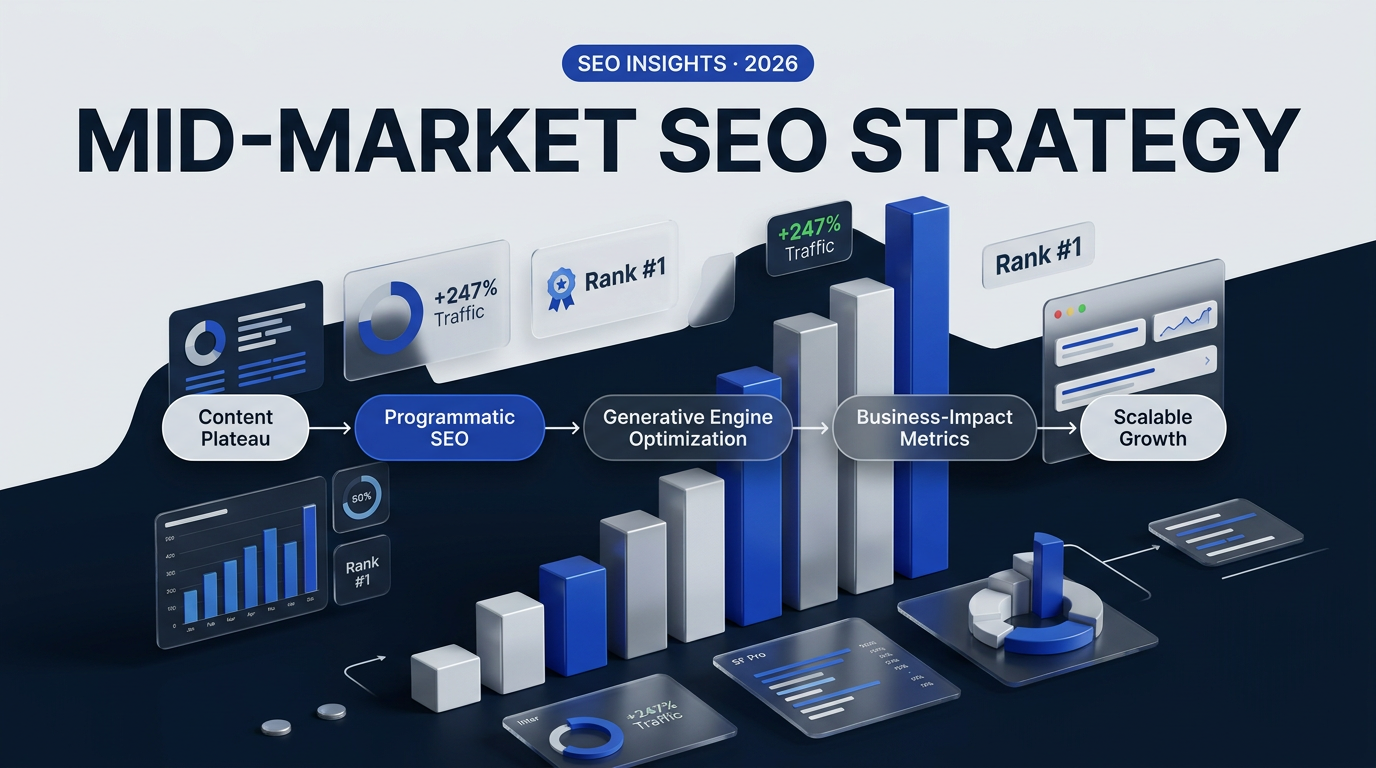
Scaling organic traffic as a mid-market business in 2026 requires moving beyond the content treadmill and embracing a more sophisticated, scalable strategy. The path forward involves three core pivots:
- Embrace GEO: Shift your focus from clicks to citations. Optimize your content to be the source of truth for AI search engines using advanced structured data and amplified E-E-A-T.
- Build with Programmatic SEO: Stop writing content one piece at a time. Identify scalable query patterns and build templated pages that can target thousands of long-tail keywords, creating a powerful growth engine.
- Atomize Your Best Content: Maximize the ROI of your high-intent assets like webinars and whitepapers by breaking them down into smaller pieces to fuel your entire content ecosystem.
- Rethink Your Metrics: Ditch vanity metrics. Report on business outcomes like pipeline influence, conversion rates, and Share of Citation to prove the real value of your modern mid-market SEO strategy.