Scaling Organic Traffic: A Proven SEO Blueprint for Mid-Market Brands
You've done everything right. You invested in a great website, built a consistent blog, and targeted keywords your customers are searching for. For a while, the traffic graph went up and to the right. But now, it's flat. Annoyingly, stubbornly flat. You're publishing more, but seeing less, and the pressure to show continued growth is mounting.
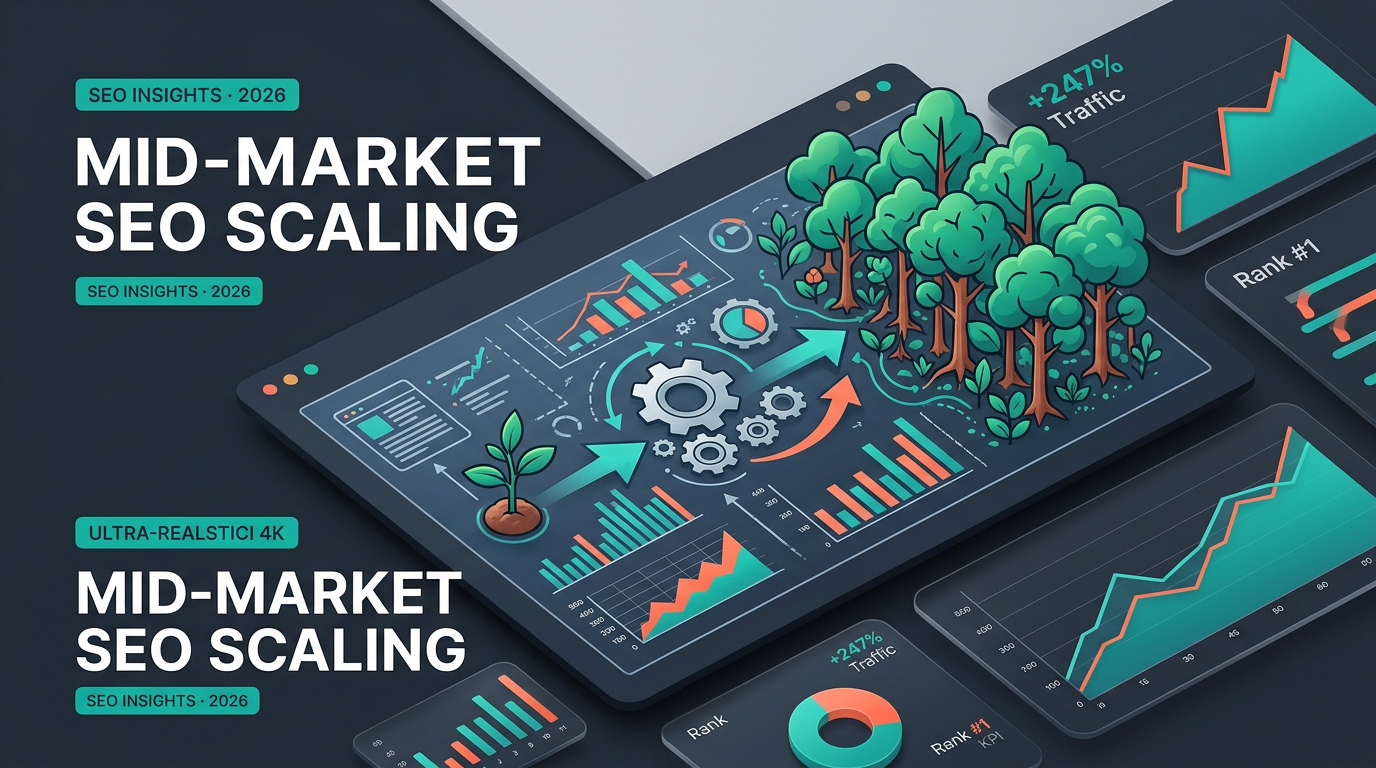
This is the classic mid-market plateau, and the solution isn't just more of the same. The tactics that got you here won't get you to the next level. It's time to evolve your strategy from simply creating content to building scalable growth engines. This is the essence of mid-market SEO scaling, a fundamental shift from manual effort to a systematic, asset-driven approach that creates a lasting competitive advantage.
Beyond the Blog: Diagnosing Your SEO Plateau
Before you can break through a plateau, you must understand what's holding you there. For most mid-market companies, traffic stagnates not from a lack of effort, but from a strategic ceiling. You've likely maximized the initial, content-driven phase of SEO. The culprit is usually one or more of the following.
Your team is probably facing one of these common roadblocks. The key is to recognize that doubling down on the old strategy—just writing more blog posts—will only lead to burnout and diminishing returns. The path forward requires a new perspective on what an “SEO asset” can be.
- Content Saturation: You've successfully covered the primary “head” and “torso” keywords in your niche. New articles now target increasingly obscure long-tail keywords with minimal traffic potential or, worse, cannibalize your existing rankings.
- Competitive Squeeze: Your niche has become more crowded. Larger competitors with deeper pockets are out-ranking you on broad terms, while nimble startups are picking off niche topics.
- The Manual Content Treadmill: Your entire strategy relies on the manual, one-by-one creation of articles. This is linear growth—one article produces X traffic. To 10x your traffic, you believe you need to 10x your content output, which is rarely feasible.
- Technical & Architectural Limits: Your CMS and site structure were built for a 50-page website, not a 5,000-page one. It’s become difficult to implement changes, manage internal linking, or launch new types of pages at scale.
The Core Principle: From Manual Content to Programmatic Growth
The secret to exponential growth lies in shifting your mindset from being a “content creator” to an “engine builder.” Instead of writing one article, you design a system that can generate hundreds or thousands of high-quality, targeted pages. This approach is often called programmatic SEO, and it's the engine behind the massive organic visibility of sites like Zillow, Zapier, and HubSpot.
As detailed in an insightful CXL article on scaling traffic without endless blog posts, this marks the evolution from a “content-driven” site to an “inventory-driven” one. Your “inventory” isn't just products; it's any dataset that can be programmatically combined with a template to create a unique, valuable page that answers a specific user need. It's the difference between hand-crafting a single car and building a factory assembly line.
For a mid-market brand, this “inventory” could be:
- A B2B SaaS company’s list of integrations.
- A financial services firm’s database of loan types.
- An e-commerce brand’s product attributes (e.g., color, material, use case).
- A service company's list of locations and associated services.
By creating a template for “How to integrate [Our Tool] with [Integration Partner]” or “[Service] in [City], [State]”, you can turn a simple spreadsheet of data into hundreds of highly relevant, search-engine-friendly landing pages that capture long-tail intent at scale.
Your Blueprint for Identifying Scalable Assets
Great opportunities for programmatic growth are rarely obvious. They are discovered at the intersection of user intent, your business's unique data, and competitive gaps. Following this blueprint will help you uncover the hidden goldmines within your own business.
- Start with Search Patterns, Not Keywords: Shift your keyword research from finding individual phrases to identifying repeatable patterns or “query syntax.” Use tools like Ahrefs or Semrush to look for modifiers that users append to your core topics. Look for patterns like:
- Transactional: “best [product category] for [use case]”
- Comparison: “[your brand] vs [competitor]”, “[competitor] alternatives”
- Integration: “integrate [your tool] with [other tool]”
- Geographic: “[your service] in [city/neighborhood]”
- Mine Your Internal Data: Your company is already sitting on a treasure trove of scalable ideas. Dig into your customer support tickets, sales call notes, and on-site search logs. What questions are asked over and over? What features do customers want to compare? Each repeated question is a potential template.
- Deconstruct Your Competitors' Architecture: Stop looking at your competitors' blogs. Instead, analyze their site structure. How are they generating thousands of pages? Are they using templates for case studies, glossaries, city pages, or tool comparisons? As some SEO experts point out, focusing on these high-intent, bottom-of-funnel page types is crucial. Reverse-engineer their approach and identify how you can create a better, more valuable version.
Building Your Scalable Engine: Tools, Templates, and Teams
Identifying an opportunity is the first step. Executing it requires a blend of smart design, the right technology, and cross-functional collaboration. This is where the blueprint becomes a tangible project.
Designing the Master Template
Your template is the DNA of your programmatic pages. It must be flexible enough to accommodate different data points but structured enough to provide a consistent, high-quality user experience. A strong master template includes:
- A dynamic H1 and title tag (e.g., “Best [Product] for [Use Case] in 2026”).
- A unique, high-quality introductory paragraph. This is a great place to leverage AI for a first draft, followed by human review and editing.
- Structured content blocks that pull from your database (e.g., product specs, pricing, location data).
- Unique value-adds: customer reviews, expert commentary, user-generated photos, or an interactive calculator. This is what separates you from low-quality programmatic spam.
- Strong calls-to-action (CTAs) relevant to the page's intent.
- Schema markup (structured data) to help search engines understand the page content (e.g., Product, FAQ, LocalBusiness schema).
The Tech Stack for Mid-Market
You don't need a Google-sized engineering team. Modern tools have made programmatic SEO more accessible than ever:
- Advanced CMS Platforms: Systems like Webflow's CMS Collections or HubSpot's HubDB are designed for this. They allow you to create a database and a template that generates pages automatically.
- Headless CMS + Front-end Framework: For more complex projects, pairing a headless CMS (like Contentful or Strapi) with a framework like Next.js or Nuxt gives you ultimate flexibility.
- No-Code/Low-Code Tools: Platforms like Airtable and Softr can be used to quickly prototype and even launch simple programmatic projects without heavy development resources.
Collaborating with Development
To get this built, you must translate your SEO vision into a clear, actionable brief for your development team. Don't just say “we need programmatic pages.” Provide a detailed spec, including the URL structure, the data sources for every element on the template, the exact schema markup required, and the success metrics you'll be tracking.
Activating and Amplifying: Launch and Internal Linking
A common mistake is believing that “if you build it, Google will find it.” A successful launch requires a deliberate strategy for discoverability, indexation, and authority building.
First, don't launch 10,000 pages at once. Start with a phased rollout, perhaps 50-100 pages representing a cross-section of your data. This allows you to monitor Google Search Console for any indexation issues, check for errors, and gather initial performance data without risking your entire site.
Second, you must build a robust internal linking structure. Your new pages will have no authority on their own. Create a primary “hub” or directory page that links out to all your new programmatic pages (e.g., a “Browse All Integrations” page). More importantly, contextually link to your new scalable assets from your high-traffic blog posts and core service pages. This funnels existing authority to your new pages and helps both users and search engines discover them.
Future-Proofing Your Strategy for 2026 and Beyond
A programmatic approach isn't just about scaling traffic today; it's about building a foundation for the future of search. As search engines become more complex, relying on AI and multiple data formats, this strategy positions you to win.
- Dominating AI Overviews: Google's AI Overviews and other generative search experiences are built on structured, factual data. By creating thousands of pages with specific, well-structured answers (e.g., “What is the price of [service] in [city]?”), you are creating the perfect source material for these AI models to cite.
- Building E-E-A-T at Scale: Programmatic doesn't mean soulless. You can build Expertise, Experience, Authoritativeness, and Trustworthiness into your templates. Incorporate author bios for the template designer, cite data sources, feature customer testimonials, and establish clear editorial guidelines for any AI-assisted content.
- Preparing for a Multimodal World: The principles of scaling aren't limited to text. You can apply the same template-and-database logic to create videos (“How to use [feature]”), images, or audio summaries at scale, meeting users wherever and however they choose to search.
Key Takeaways
Scaling organic traffic in today's competitive landscape requires a strategic evolution. Moving beyond the manual content treadmill is no longer optional for ambitious mid-market brands. By adopting a programmatic mindset, you can build a sustainable, scalable SEO engine that drives growth for years to come.
- Diagnose the Plateau: Understand that linear content effort leads to diminishing returns.
- Shift to a Scalable Mindset: Think like an engine builder, not just a content creator. Turn your unique data into an inventory of SEO assets.
- Find the Pattern: Use query syntax, internal data, and competitive analysis to identify opportunities for scalable page templates.
- Build a Value-Packed Template: Design a master template that blends programmatic data with unique value-adds like reviews, expert quotes, and rich structured data.
- Launch and Link Strategically: Roll out your pages in phases and build a strong internal linking structure to funnel authority and aid discovery.
- Measure Business Impact: Track indexation, rankings, and traffic, but focus on the ultimate goal: conversions and revenue generated from your new scalable assets.