Scaling Organic Traffic: Mid-Market SEO Strategies for Sustainable Growth
You’ve graduated from the startup sandbox. The frantic scramble for any-and-all traffic is over, but you’re not an enterprise giant with unlimited resources either. You’re in the mid-market, a competitive space where the old SEO playbook—churning out blog posts for every conceivable keyword—is delivering diminishing returns. You need to grow smarter, not just harder.
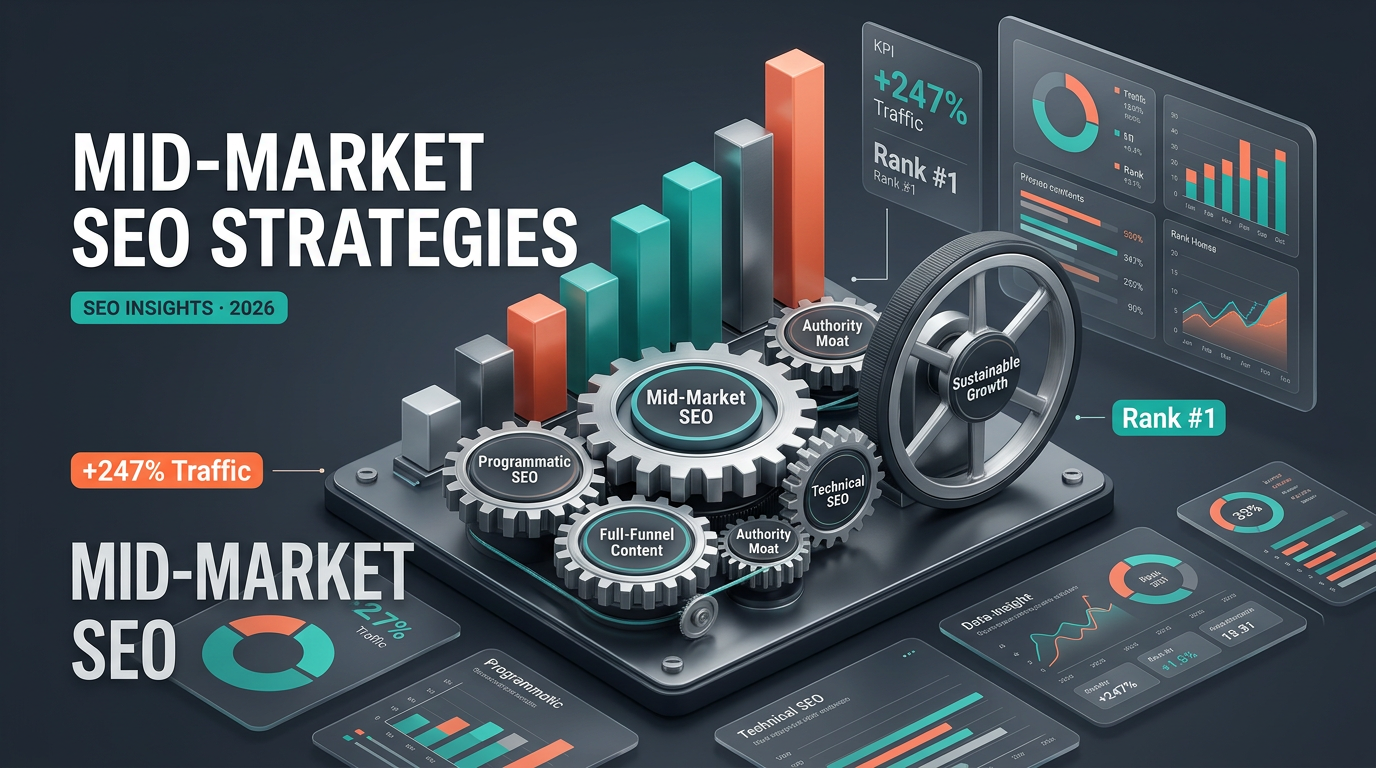
It’s time to evolve your approach. Sustainable growth requires sophisticated, scalable, and integrated mid-market SEO strategies that build compounding value over time. This isn’t about finding a few new keywords; it’s about re-architecting your entire organic growth engine to be more efficient, defensible, and tied directly to revenue.
Beyond the Blog: The Mid-Market SEO Maturity Shift
Mid-market companies occupy a unique position: you have more data and brand recognition than a startup, but more agility and less bureaucracy than a massive enterprise. This is your strategic advantage. While your competitors are stuck in their respective playbooks, you have the flexibility to adopt a more disciplined, full-funnel approach to growth, much like the shift toward growth marketing in scaling companies.
For SEO, this means moving from a content-centric model to an asset-centric one. A blog post is a depreciating asset; its value peaks shortly after publication and then slowly declines. An SEO asset, on the other hand, is a system designed for compounding growth. It could be a programmatic landing page system, a suite of free tools, or a library of expert-driven resources that continuously accrues authority and traffic.
This maturity shift requires a change in mindset. Stop thinking like a publisher and start thinking like a product owner. Your website's organic presence is a product to be iterated on, optimized, and scaled. The goal is to build sustainable systems that generate predictable traffic and, more importantly, predictable revenue.
Strategy 1: Programmatic & Product-Led SEO
One of the most powerful levers for scalable growth is programmatic SEO. This is the strategy of creating hundreds or thousands of optimized pages from a single template and a structured data source. It’s how companies like Zillow, TripAdvisor, and Zapier dominate long-tail search. But you don't need to be a massive platform to leverage this; mid-market companies can apply the same principles.
This approach moves beyond creating individual articles and focuses on building scalable page types that target entire categories of user intent. As CXL notes, this is a key way to scale organic traffic without writing a million blog posts. The key is to identify a repeatable search pattern relevant to your business and build a template to serve it.
Examples of Programmatic SEO for Mid-Market:
- B2B SaaS: Create templates for "[Your Product] vs. [Competitor]" pages, "[Your Product] Alternatives," or "[Your Product] Integration with [Other Tool]." Each page can be programmatically generated with unique data points.
- E-commerce: Develop pages for "[Product Category] for [Specific Use Case]" (e.g., "Running Shoes for Flat Feet") or "Best [Product] under [Price Point]."
- Service Companies: Build out hyper-local landing pages at scale for "[Your Service] in [City/Neighborhood]."
- Marketplaces: Generate profile pages for every provider or listing, optimized for name- and location-based searches.
To get started, audit your search console data and keyword research for recurring patterns or modifiers (vs, alternative, for, in, near me). These patterns are your roadmap to a scalable programmatic project that can 10x your organic footprint with a fraction of the effort of manual content creation.
Strategy 2: Full-Funnel Content Optimization
Too many SEO strategies are obsessed with top-of-funnel (ToFu) acquisition. For a mid-market business, that’s a critical leak in the bucket. You need to use SEO to influence the entire customer journey, from initial awareness to activation, retention, and even expansion. Your customers are Googling their problems at every stage, not just when they first discover you.
Start mapping your customer journey and identifying the questions they ask at each stage. Then, create and optimize content specifically to answer them. This transforms SEO from a simple lead generation channel into a powerful customer success and revenue expansion engine. Think about the ROI of preventing one customer from churning because they found the exact help document they needed through a quick Google search.
Content to Optimize Across the Funnel:
- Middle of Funnel (MoFu): These searchers are solution-aware. Target them with content that helps them evaluate their options. This is where your comparison pages, detailed case studies, and ROI calculators shine.
- Bottom of Funnel (BoFu): These are high-intent searchers ready to buy. Optimize your product/service pages, pricing pages, and implementation guides for keywords that signal commercial intent, like "pricing," "demo," "trial," or "buy."
- Post-Purchase (Activation & Retention): This is your biggest missed opportunity. Your help center, knowledge base, and API documentation should be public-facing and optimized for search. Capture traffic from users searching things like "how to integrate [your product] with salesforce" or "[your product] troubleshooting." This reduces support tickets and increases product adoption.
Strategy 3: The Content-Technical Hybrid Approach
In the mid-market, you can't afford to have your content team and technical SEO team (or specialist) operating in silos. Your biggest wins will come from the intersection of great content and technical precision. This hybrid approach ensures that your valuable content assets are discovered, crawled, and understood perfectly by search engines.
Two of the highest-leverage areas for this collaboration are internal linking and structured data. A well-executed internal linking strategy acts as a circulatory system, distributing authority from your high-link pages to the pages that convert. Advanced structured data, meanwhile, helps you dominate the SERPs with rich results, giving you more visibility and higher click-through rates.
A 3-Step Structured Data Overhaul:
- Audit and Identify: Crawl your site and identify all pages that qualify for advanced schema types. Key opportunities include Product, Service, FAQPage (for landing pages and blogs), HowTo (for tutorials), and VideoObject.
- Implement and Validate: Use tools like Google's Rich Results Test to deploy and validate your structured data. Prioritize implementation on your highest-value pages first—your core service pages, product pages, and top-performing blog posts.
- Monitor Performance: Use Google Search Console's Performance report to track the clicks and impressions for pages with rich results. Look for uplifts in CTR as a sign of success and identify new opportunities for schema enhancement.
Strategy 4: Building Your Authority Moat
As a mid-market player, you’re squeezed from two sides: nimble startups trying to out-maneuver you and enterprises trying to outspend you. Your defense is a strong authority moat built on genuine expertise, trust, and unique data. This goes beyond basic link building and establishes your brand as an indispensable resource in your industry.
An authority moat makes your rankings more resilient to algorithm updates and competitor attacks. Google wants to rank authorities, and by investing in initiatives that demonstrate true expertise, you align your goals directly with Google's. This is how you build long-term, defensible rankings.
Pillars of an Authority Moat:
- Proprietary Data & Industry Reports: Analyze your internal (anonymized) product/service data or conduct original surveys to create one-of-a-kind industry reports. These assets are magnets for high-authority backlinks from journalists, academics, and other industry players.
- Expert-Led Content: Stop publishing generic content from anonymous authors. Put your subject matter experts—your engineers, product managers, and C-suite—front and center. Feature their bylines, create expert profile pages, and get them on relevant podcasts.
- Targeted Digital PR: Instead of spray-and-pray outreach, build real relationships with journalists and editors at the key trade publications your customers actually read. A single link from a top-tier niche publication is worth more than 100 links from low-quality directories.
Key Takeaways
To succeed with SEO in the mid-market, you must evolve beyond the basics. Your path to sustainable organic growth in 2026 and beyond relies on a strategic shift in focus. Here’s a summary of your new playbook:
- Embrace Scalability: Move from one-off content creation to programmatic and product-led SEO to capture long-tail traffic at scale.
- Optimize the Full Funnel: Use SEO to support customers at every stage, from awareness to retention, turning your organic presence into a revenue and customer success engine.
- Integrate Content & Technical SEO: Fuse your content strategy with technical precision, focusing on high-impact initiatives like internal linking and advanced structured data.
- Build a Defensible Moat: Invest in proprietary data, expert-led content, and targeted digital PR to establish unshakeable authority in your niche.