
Topic Clusters: The Advanced SEO Tactic Dominating Search Today
Remember the old days of SEO? The game was simple, if a bit clumsy: pick a keyword, write a page, and stuff that keyword in as many times as you could without it sounding completely robotic. That era is dead and buried. Today, in a world dominated by semantic search and emerging AI answer engines, Google doesn’t just want to see pages; it wants to see expertise.
This is where a sophisticated strategy separates the winners from the websites that get left behind. Enter the solution that is defining modern content strategy: topic clusters SEO. This is not just a new buzzword; it's a fundamental shift in how we plan, create, and organize content to build undeniable authority, making your website the go-to source for both human searchers and artificial intelligence.
What Are Topic Clusters (And Why They're Non-Negotiable in 2026)
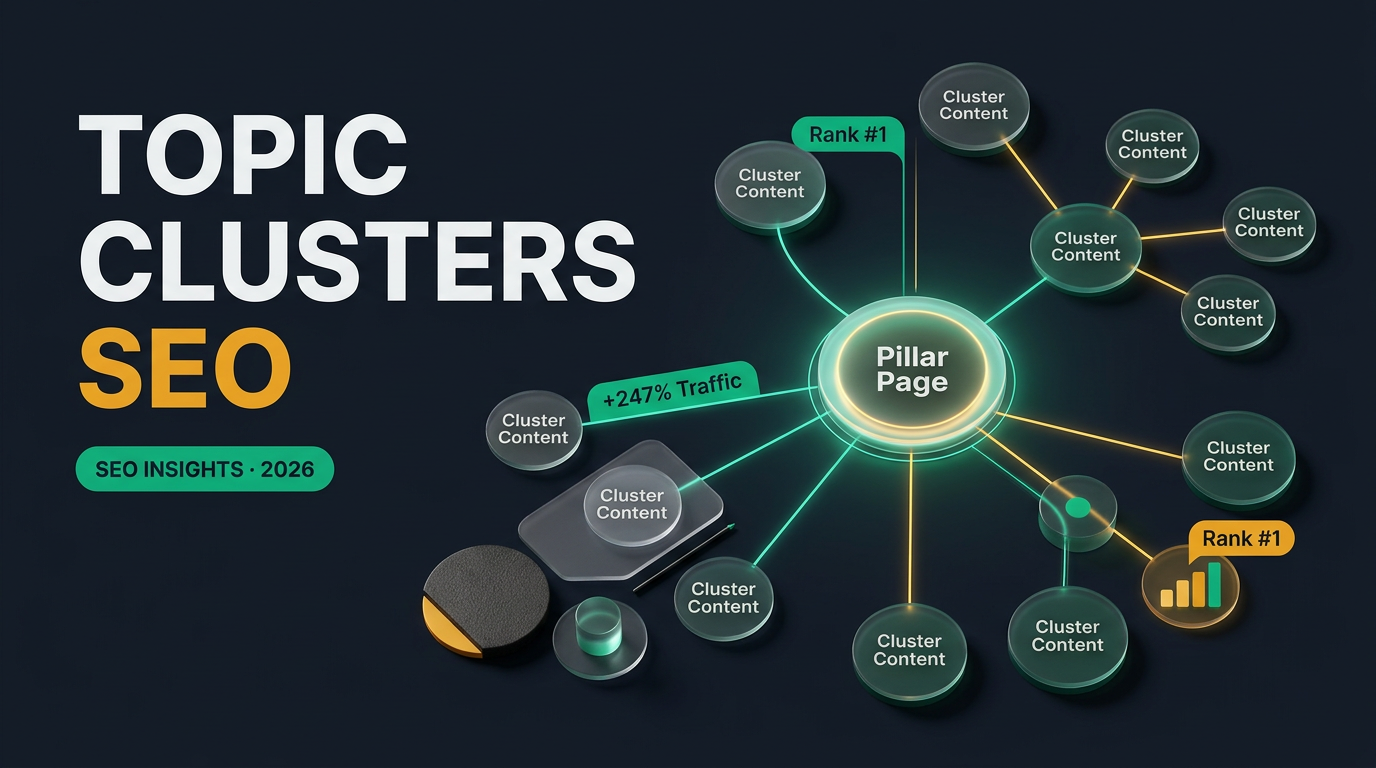
At its core, a topic cluster is a method of website content architecture that groups related pages together to signal depth of knowledge on a subject. Instead of having dozens of disconnected blog posts, you create an interconnected ecosystem of content. This model, championed by SEO platforms like Moz, consists of three primary components that work in harmony.
- The Pillar Page: This is the heart of your cluster. It’s a comprehensive, high-level guide covering a broad topic (e.g., “Digital Marketing for Small Business”). It targets a high-volume, competitive keyword and serves as the central hub.
- Cluster Content: These are individual pages or articles that explore specific subtopics related to the pillar in greater detail (e.g., “Local SEO Basics,” “Email Marketing ROI,” “Social Media Content Calendar”). Each piece targets a more specific, long-tail keyword.
- Internal Links: This is the glue that holds the entire structure together. Every cluster page links up to the pillar page. In turn, the pillar page links out to each of the relevant cluster pages, often from a dedicated section that acts as a table of contents for the entire topic.
The reason this model is so dominant in 2026 is because search has evolved. Google now functions as an “answer engine,” aiming to understand the contextual relationship between concepts. It no longer just matches keywords; it connects ideas. Topic clusters perfectly mirror this semantic approach. They prove to algorithms that your site has covered a topic from every important angle, making you a more credible and authoritative source.
Furthermore, this structure is crucial for visibility in AI-driven search results like Google's AI Overviews. When a user asks a complex question, the AI performs what Semrush calls “query fan-out,” breaking the prompt into multiple related questions to synthesize an answer. A well-built topic cluster has already answered these sub-queries, making your content a prime candidate for citation and inclusion in AI-generated responses.
The Strategic Payoff: Business Benefits Beyond Rankings
While the primary goal of topic clusters SEO is to improve search visibility, the business impact extends far beyond just ranking higher. Adopting this model creates a flywheel effect that strengthens your entire digital marketing funnel, turning your website into a powerful asset for growth and customer acquisition. When you move from a keyword-centric to a topic-centric strategy, you begin to see tangible business results.
These benefits compound over time, creating a defensible moat around your core areas of expertise. Instead of fighting for individual keyword rankings, you are competing to own entire conversations in your industry. This is a far more sustainable and powerful position to be in for the long term.
- Builds Impenetrable Topical Authority: By comprehensively covering a subject, you send powerful signals to Google and users that you are a definitive expert. This authority makes it easier to rank for all related terms within that topic.
- Drives Highly Qualified Traffic: The pillar page attracts users with broad, top-of-funnel intent, while the cluster pages capture users with specific, bottom-of-funnel questions. This means you connect with potential customers at every stage of their journey.
- Boosts User Engagement and Conversions: The logical internal linking structure makes it easy for users to find related information, keeping them on your site longer. This deep engagement builds trust and naturally guides them toward your products or services.
- Future-Proofs Your SEO for an AI World: As AI search becomes more prevalent, your organized, comprehensive, and interconnected content becomes a reliable dataset for AI to learn from and cite, ensuring your brand's voice is part of future answers.
- Eliminates Content Cannibalization: A common issue is having multiple pages accidentally competing for the same keyword. Topic clustering prevents this by assigning a clear, unique intent and target keyword to each page within the framework.
The 5-Step Blueprint for Building Your First Topic Cluster
Building a topic cluster isn't just about writing more content; it's about being more strategic. Following a structured process ensures your efforts are focused and your final cluster is a cohesive, high-performing asset. This blueprint will guide you from initial idea to a fully architected cluster.
- Step 1: Ideate Your Core Pillar Topic. Your pillar is the foundation. Choose a broad topic that is central to your business and represents a problem you solve for your customers. It should be 2-4 words, have significant monthly search volume, and be something you can realistically create at least 5-10 detailed sub-articles about. For a SaaS accounting firm, a great pillar might be “small business bookkeeping,” not just “bookkeeping.”
- Step 2: Map Out Your Cluster Subtopics. This is the brainstorming phase. Use tools like Google's "People Also Ask," AnswerThePublic, and your preferred keyword research tool to identify all the questions, problems, and related concepts around your pillar. Think like your customer: What are their specific pain points? This will become your list of cluster content ideas (e.g., “how to choose bookkeeping software,” “bookkeeping best practices,” “common bookkeeping mistakes”).
- Step 3: Conduct a Content Audit & Create Your Assets. Before you write a single new word, check what you already have. Do you have existing blog posts that could be updated and optimized to serve as a cluster page? Audit your existing content, identify what can be repurposed, and then create a production plan for the missing pieces. Every piece must be high-quality and satisfy the specific user intent for its target keyword.
- Step 4: Architect Your Internal Linking. This is the most critical and often-missed step. The linking rules are simple but strict. Every single cluster page must link contextually back to the main pillar page. Then, the pillar page must link out to every single one of its child cluster pages. This creates a powerful, closed loop that funnels authority to the pillar and distributes it across the cluster.
- Step 5: Design the Pillar Page as a True Hub. Your pillar page is not just a very long blog post. It must be designed as a central resource. Include a clear introduction that defines the topic, and then create a dedicated section that acts as a visual or text-based table of contents, with clear headings and links pointing to each of your cluster pages. This improves user experience and makes the structure crystal clear for search engine crawlers.
Advanced Tactics: Scaling and Optimizing Your Clusters in 2026
Building your first topic cluster is a huge win, but the real experts know that clusters are living ecosystems, not “set it and forget it” projects. To truly dominate, you need to continuously optimize, expand, and refine your clusters using data and emerging technologies. This is how you stay ahead of the competition.
Think of yourself as a digital gardener. Your initial cluster is the first planting. Now you must tend to it, prune what isn't working, and plant new seeds to expand your garden's reach and health. This iterative process is what separates good SEO from great SEO.
- Leverage AI for Gap Analysis: Use AI-powered SEO tools to analyze the top-ranking competing clusters. These tools can perform a semantic analysis to identify subtopics and user questions that your competitors are answering but you are not. This provides an instant roadmap for creating new cluster content to fill those gaps and make your cluster more comprehensive.
- Implement a Content Pruning & Merging Cycle: Not every cluster page will be a home run. Set up a quarterly review. Identify cluster pages with low traffic, engagement, and rankings. If a page is truly irrelevant, prune it and redirect the URL. If two pages are competing or have significant content overlap, merge them into a single, stronger piece to consolidate authority.
- Integrate Multimodal Content: Your cluster pages don't all have to be articles. In 2026, a world-class cluster should be a rich, multimedia experience. Create cluster content in the form of YouTube videos, podcasts with transcripts, free downloadable templates, or interactive tools. This caters to different user preferences and creates more powerful engagement signals.
- Measure ROI at the Cluster Level: Stop measuring success one keyword at a time. In your analytics, create content groupings for each cluster. Measure the cluster's collective organic traffic, the number of unique keywords the entire cluster ranks for, and, most importantly, the leads or conversions generated from the group of pages as a whole. This gives you a true measure of the strategy's business impact.
Common Mistakes to Avoid in Your Topic Cluster Strategy
The topic cluster model is powerful, but it’s easy to make mistakes that can undermine your efforts. Being aware of these common pitfalls from the start can save you countless hours of rework and ensure your strategy delivers the results you expect. Avoiding these errors is just as important as following the best practices.
Many of these mistakes stem from a failure to fully commit to the model's architecture. A half-hearted attempt, like creating a few posts on a related theme without the proper pillar and linking structure, will not produce the desired authority signals. Go all-in or you risk seeing minimal return on your content investment.
- Choosing a Pillar That's Too Broad or Too Niche: A pillar like “Marketing” is too vast to ever own. A pillar like “left-handed social media marketing for dentists” is too narrow to have an impact. Find the sweet spot that is core to your business and has enough search interest to justify the effort.
- Forgetting the Internal Linking Architecture: This is the number one mistake. Content without the correct linking structure is just a collection of articles, not a topic cluster. The `pillar <=> cluster` linking is non-negotiable and must be implemented precisely.
- Creating Overlapping Cluster Content: Ensure each cluster page has a distinct purpose and targets a unique long-tail keyword. If two of your cluster pages could answer the same question, you're creating keyword cannibalization and diluting your authority.
- Treating the Pillar Page Like a Standard Blog Post: A pillar page needs to be a navigational hub. If it lacks a clear table of contents or sections that link out to the cluster pages, it fails in its primary role of organizing the topic for users and search engines.
- Ignoring Performance Data: Launching a cluster and never looking back is a recipe for mediocrity. You must track the performance of the cluster as a whole. Which pages are driving traffic? Which aren't? Use this data to guide your optimization and expansion efforts.
Key Takeaways
As we move deeper into an era defined by semantic and AI-driven search, building topical authority is the most durable SEO strategy. Topic clusters are the most effective vehicle for achieving this. Here's what to remember:
- Focus on owning topics, not just ranking for individual keywords.
- The core structure is a central Pillar Page linked to and from multiple Cluster Content pages.
- A disciplined internal linking strategy is the glue that makes the model work.
- Topic clusters build authority that benefits both traditional search rankings and visibility in AI answers.
- Building clusters is an ongoing process. You must measure, audit, and expand them based on performance data to win.